


		<div class="wpcnt">
			<div class="wpa">
				<span class="wpa-about">Advertisements</span>
				<div class="u top_amp">
							<amp-ad width="300" height="265"
		 type="pubmine"
		 data-siteid="111265417"
		 data-section="2">
		</amp-ad>
				</div>
			</div>
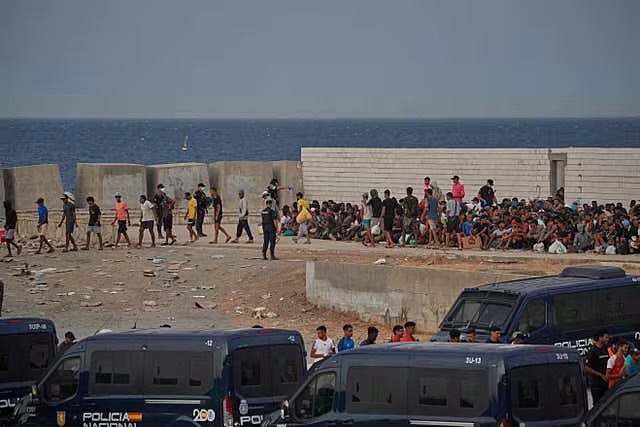
		</div><p><strong>For weeks, migrants in the Spanish territory of Ceuta had gathered on a beach away from the city centre, sleeping on cardboard sheets, under reed huts and guarding their few possessions in tattered plastic bags.</p>
<p>They were gone by Thursday morning after Spanish police escorted them to makeshift shelters.</p>
<p>But an hour later, other migrants were combing through the rubbish they had left behind for anything useful: an abandoned mattress, plastic chairs, sheets, a scrap of tarpaulin.</strong></p>
<p>The scene exemplified the ongoing humanitarian crisis in Ceuta, where up to 10,000 migrants remain in the city weeks after more than 72,000 people poured into the small Spanish territory from neighbouring Morocco.</p>
<figure id="attachment_188540" aria-describedby="caption-attachment-188540" style="width: 640px" class="wp-caption alignnone"><img src="https://londonglossy.com/wp-content/uploads/2026/08/IMG_2340.jpeg" alt="" width="640" height="427" class="size-full wp-image-188540" /><figcaption id="caption-attachment-188540" class="wp-caption-text">Cleaning staff clear the El Trampolin beach, where migrants who crossed from Morocco into Spain stayed in the Spanish enclave of Ceuta</figcaption></figure>
<p>Three weeks later, Spanish authorities were struggling to shelter and attend to those who refused to leave, or even determine how many migrants were still in the city of 84,000.</p>
<p>Within days of the initial border rush, in which at least 90 people died, most migrants went back to Morocco, realising the difficulties of staying in Ceuta and their slim chances of reaching mainland Europe.</p>
<p>But thousands remained, hiding in the woods, on beaches and outside a migrant reception centre.</p>
<p>City officials estimate that 9,000 to 10,000 migrants, including about 2,000 minors, could still be in the city, based on the number of daily food rations handed out by aid groups.</p>
<p>Spain’s interior ministry puts the figure at roughly 5,000 people.</p>
<figure id="attachment_188543" aria-describedby="caption-attachment-188543" style="width: 640px" class="wp-caption alignnone"><img src="https://londonglossy.com/wp-content/uploads/2026/08/IMG_2342.jpeg" alt="" width="640" height="427" class="size-full wp-image-188543" /><figcaption id="caption-attachment-188543" class="wp-caption-text">Migrants line up for food distribution on a beach in Ceuta</figcaption></figure>
<p>The UN refugee agency highlighted large humanitarian and operational challenges in Ceuta in an interview with The Associated Press, specifically around access to shelter, basic services and food.</p>
<p>While most of those who crossed in late July are from Morocco, people from war-torn Sudan, Mali and Yemen also reached the Spanish exclave.</p>
<p>The UN refugee agency urged Spanish authorities to start processing their asylum claims as soon as possible, estimating that about 1,200 migrants in Ceuta could be eligible for international protection, according to Paula Barrachina, a spokesperson for the agency in Spain.</p>
<p>The Spanish government says it is working to house the remaining migrants in the city, and return a sense of normality to Ceuta.</p>
<p>On Thursday, Spain’s minister of inclusion, social security and migration, Elma Saiz said the government had secured space to accommodate 1,800 migrants in a car park and a military facility sometimes used for religious events. It was looking for more space.</p>
<figure id="attachment_188546" aria-describedby="caption-attachment-188546" style="width: 640px" class="wp-caption alignnone"><img src="https://londonglossy.com/wp-content/uploads/2026/08/IMG_2343.jpeg" alt="" width="640" height="427" class="size-full wp-image-188546" /><figcaption id="caption-attachment-188546" class="wp-caption-text">A migrant prays on a beach in Ceuta</figcaption></figure>
<p>Even so, an Associated Press photographer on Thursday saw migrants still roaming the streets. Elsewhere, hundreds of women and minors were sheltering in makeshift centres run by local people.</p>
<p>Khadija Rifai, 20, a woman from Morocco, acknowledged that some people were receiving help, but did not know what Spain planned to do with adults like her.</p>
<p>“They help the minors and the youngsters, but they haven’t found any solutions for us,” she said on Wednesday.</p>
<p>She said her life in Morocco was “normal” but in late July, she and her husband swam to the Spanish territory in search of better opportunities and healthcare.</p>
<p>Her husband was sent back to Morocco, but she hid from authorities and stayed. She now hopes to reunite with him and eventually move to mainland Spain, where she wants to have children.</p>
<p>“Even though we suffered here in Ceuta, we hope that once we reach the mainland, life will be good and we will have a house, a car, and everything we dreamed of,” she said.</p>
<p>Ceuta mayor Juan Jesus Vivas accused the national government, led by Socialist Prime Minister Pedro Sanchez, of not doing enough to control the situation.</p>
<p>On Thursday, Spanish police escorted several hundred people, mostly men, through the city’s streets to a shelter.</p>
<p>Hours later, Mr Vivas, a member of the centre-right Popular Party, said the government’s decision to move migrants from the beach to other locations in the city did not demonstrate “a will to fix the problem”.</p>
<p>Spain’s migration ministry said the government has allocated 6.5 million euro (£5.6 million) in emergency funds to help the city cope with the new arrivals.</p>
<p>Speaking in Ceuta this week, Ms Saiz praised the work of organisations in Ceuta and said 4,000 meals had been distributed every day since August 3.</p>
<p>A ministry spokesperson said the Spanish government has to process every case on an individual basis.</p>
<p>Before that can happen, police must identify those who entered the city illegally, verify every migrant’s nationality and background, determine who qualifies for international protection and establish who must leave, either voluntarily or by force, he said.</p>
<p>Migrants in Ceuta say they are willing to wait out the uncertainty. Hundreds had gathered earlier in the week in protest on a beach in Ceuta, carrying signs reading “Asylum” alongside Spanish flags.</p>
<p>Mohamed Yaqoub, 18, a migrant from Chad hid for days in the woods after Spanish soldiers chased him in late July, he said. He managed to stay and wishes to some day study in France.</p>
<p>Getting there will not be easy. Travellers leaving Ceuta and Melilla, Spain’s other territory in North Africa, are subject to exit checks at ports and airports, an obstacle for those who enter the territories illegally and hope to reach the European continent.</p>
<p>“We ask them to allow us entry and give us the necessary papers and documents,” Yaqoub told an AP photographer. “The most important thing for us is to get the papers.”</p>
			<div style="padding-bottom:15px;" class="wordads-tag" data-slot-type="belowpost">
				<div id="atatags-dynamic-belowpost-6ad958a370c46">
					<script type="text/javascript">
						window.getAdSnippetCallback = function () {
							if ( false === ( window.isWatlV1 ?? false ) ) {
								// Use Aditude scripts.
								window.tudeMappings = window.tudeMappings || [];
								window.tudeMappings.push( {
									divId: 'atatags-dynamic-belowpost-6ad958a370c46',
									format: 'belowpost',
								} );
							}
						}

						if ( document.readyState === 'loading' ) {
							document.addEventListener( 'DOMContentLoaded', window.getAdSnippetCallback );
						} else {
							window.getAdSnippetCallback();
						}
					</script>
				</div>
			</div>
Discover more from London Glossy Post
Subscribe to get the latest posts sent to your email.

